
Test results
1. Purpose
To measure how barrel temperature behaves during a sustained string of fire with the Arctic Flow prototype installed, and to compare those measured readings with our thermal model of the same rifle.
2. Test article
The Arctic Flow prototype is a barrel cooling kit made of three parts:
- Flexible wrap. A cooling jacket, wrapped around the barrel and held with hook-and-loop straps.
- Chilled water loop. A 12V submersible pump in a portable ammo-can cooler with two ice packs, connected to the mat by braided hoses with quick-disconnect fittings.
- Portable power. A 12V battery box with a toggle switch runs the pump. Production will use a much smaller rechargeable power supply.
This was an early hand-built prototype, not a production unit. Many further improvements are in process!
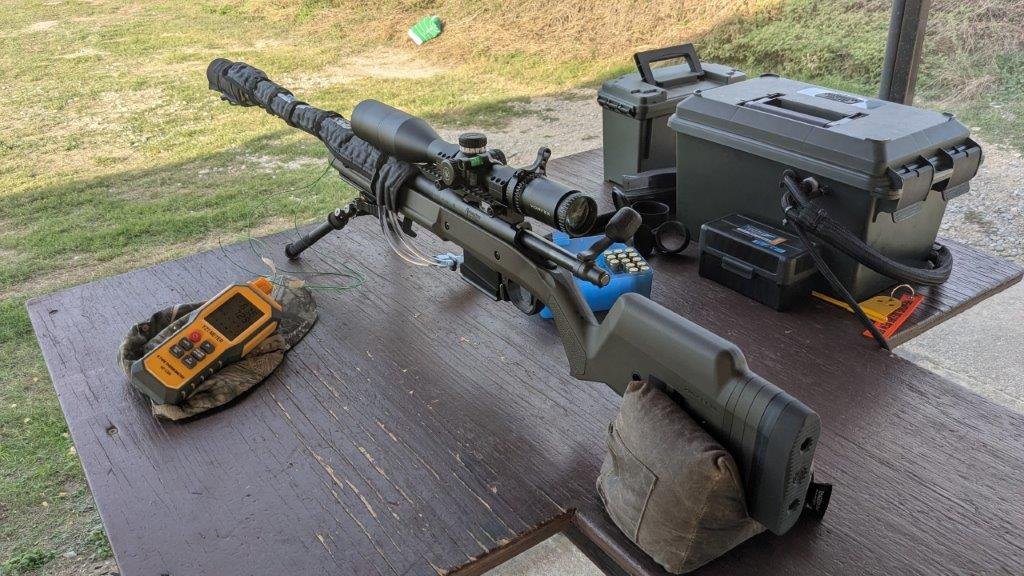
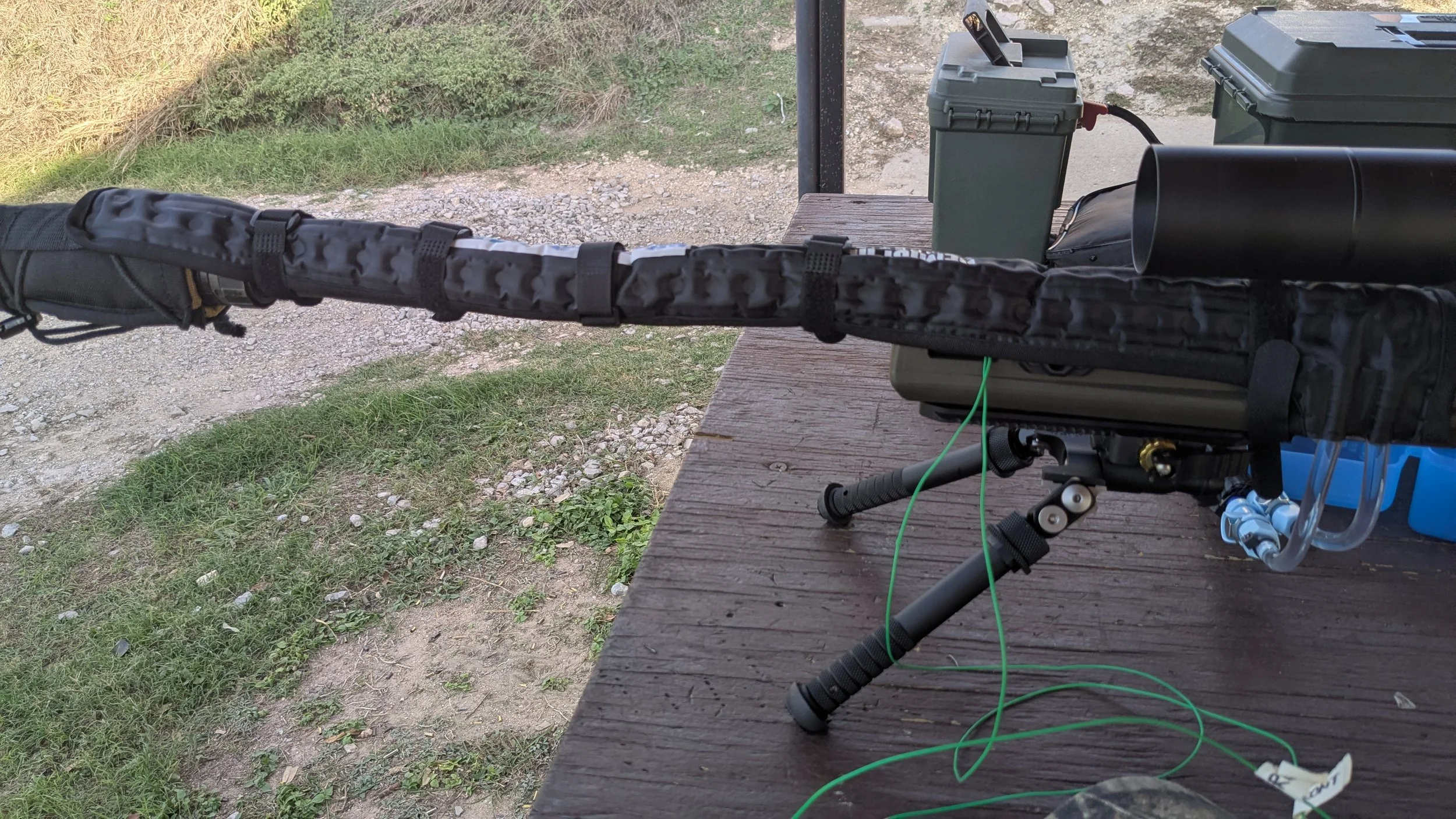
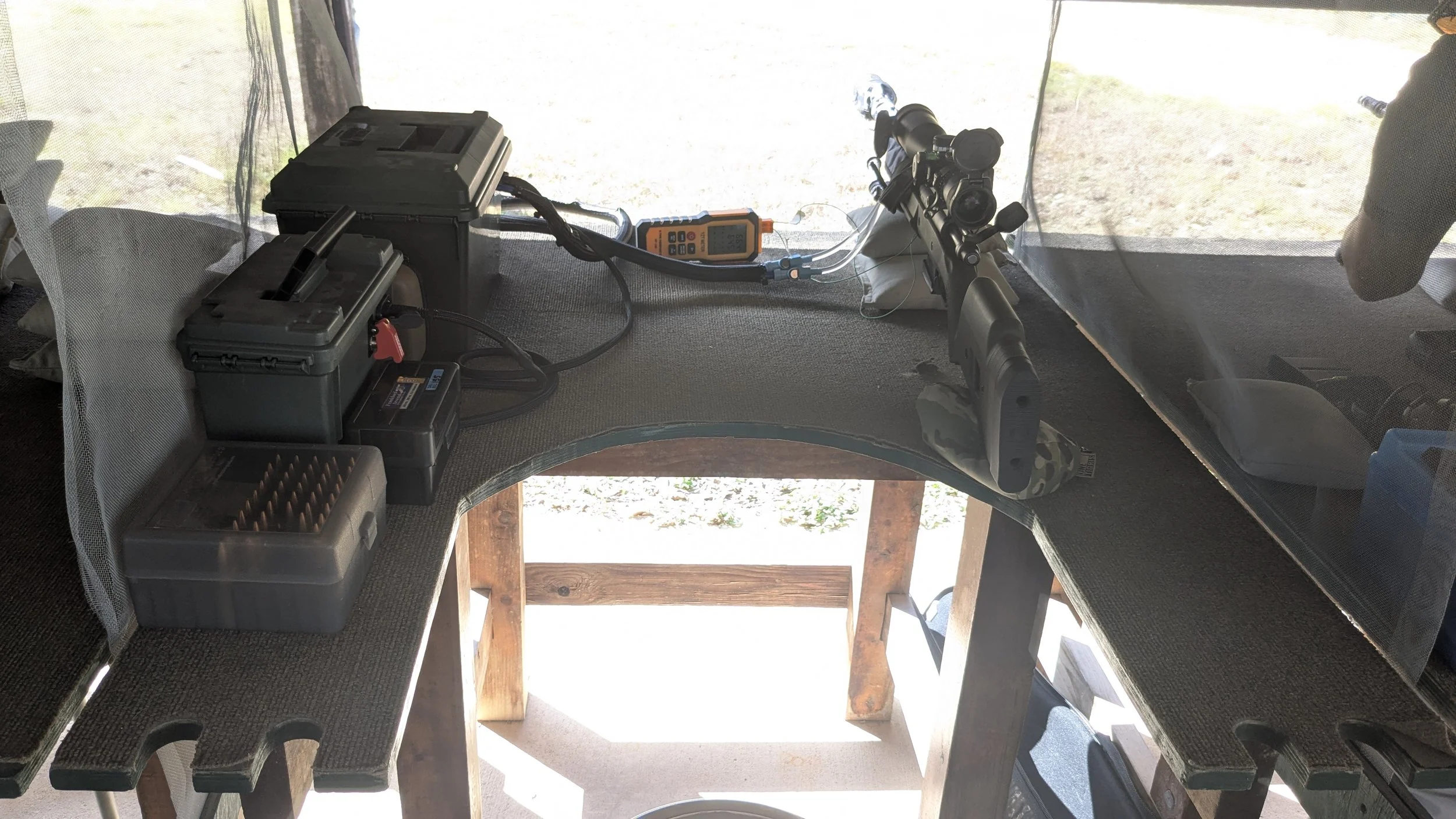


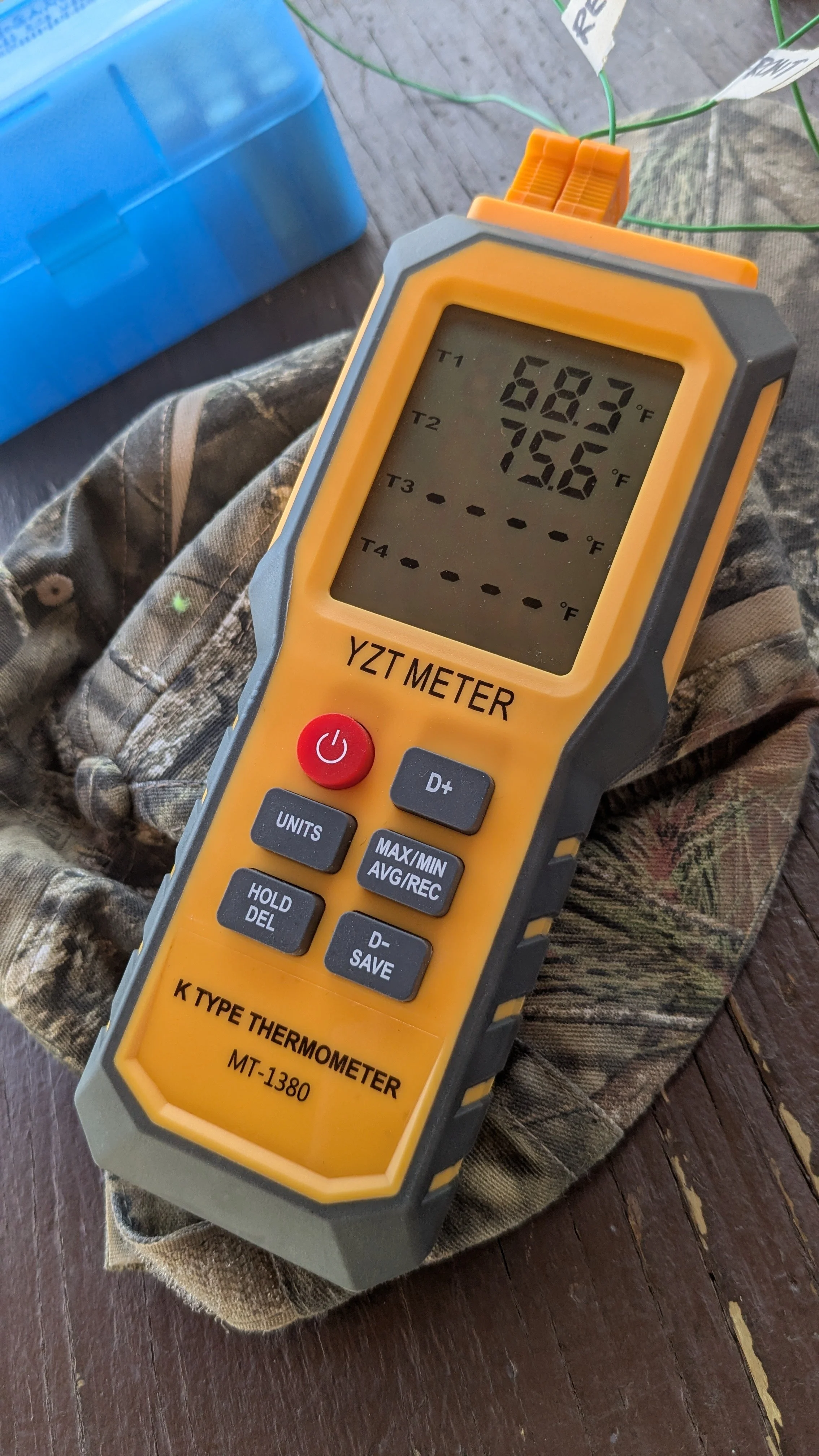
Test setup The rifle was fired from a shooting bench with a Dead Air Nomad suppressor fitted. The cooling jacket covered the barrel from the chamber all the way to the muzzle end and was held on with hook-and-loop straps. It was too long for the 26 inch barrel and scope mount combo so it overhung the suppressor a bit. The production version will be shorter. The cooler, pump, battery box and electronic temperature sensor display sat on the bench beside the rifle, and water from the cooler was pumped through the mat continuously during the session.
4. Rifle and ammunition
| Item | Detail |
|---|---|
| Action | Remington 700 |
| Stock | Magpul Hunter |
| Barrel | Rem/Age stainless steel, 26 in, 1:10 twist, full profile. |
| Caliber | .308 Win |
| Load | Sierra 155 gr MatchKing Palma HPBT @ 2,960 fps (chronograph confirmed). |
5. Instrumentation
- Thermometer: YZT MT-1380 two-channel K-type digital thermometer.
- Probes: two Type K thermocouple probes (Evolution), tagged FRONT and REAR. Channel T1 is read as the front probe and T2 as the rear probe.
- Front probe location: 3 in from the muzzle end of the barrel.
- Rear probe location: 2 in from the chamber/receiver end of the barrel.
- IR thermometer: handheld infrared gun, used for spot readings.
6. Conditions
| Item | Detail |
|---|---|
| Date and time | October 18, 2026, mid-afternoon with shaded bench |
| Location | Leander, Texas |
| Air temperature | 68–71°F (1–5 PM CT) |
| Relative humidity | 32–35% |
| Wind | About 4–5 mph, gusts to about 14 mph |
| Sky | Mostly clear (0–26% cloud cover) |
| H20 temp | Not recorded but two large ice packs were fully frozen in the water |
7. Procedure
- Install the jacket on the barrel and connect the hoses to the pump in the iced water cooler using quick disconnects.
- Switch on the pump and record a baseline reading on both probes before firing.
- Fire the 155 gr Palma load in strings, stopping between strings only long enough to photograph the thermometer and count the fired cases.
- Take IR gun spot readings at two points during the session.
8. Results (measured)
All values in this section are measured on the prototype at the range.
| Reading | Rounds fired (cumulative) | Front °F (T1) | Rear °F (T2) | Rear minus front °F | IR gun °F |
|---|---|---|---|---|---|
| Baseline | 0 | 63.6 | 59.7 | −3.9 | – |
| 1 | 13 | 67.7 | 72.9 | 5.2 | – |
| 2 | Between 13 and 20 | 68.3 | 75.6 | 7.3 | – |
| 3 | Between 13 and 20 | 69.2 | 77.8 | 8.6 | – |
| 4 | 20 | 69.2 | 79.4 | 10.2 | – |
| 5 | 23 | 70.3 | 80.8 | 10.5 | 85.1 |
| 6 | 23 (a little later, no added shots) | 70.3 | 81.2 | 10.9 | – |
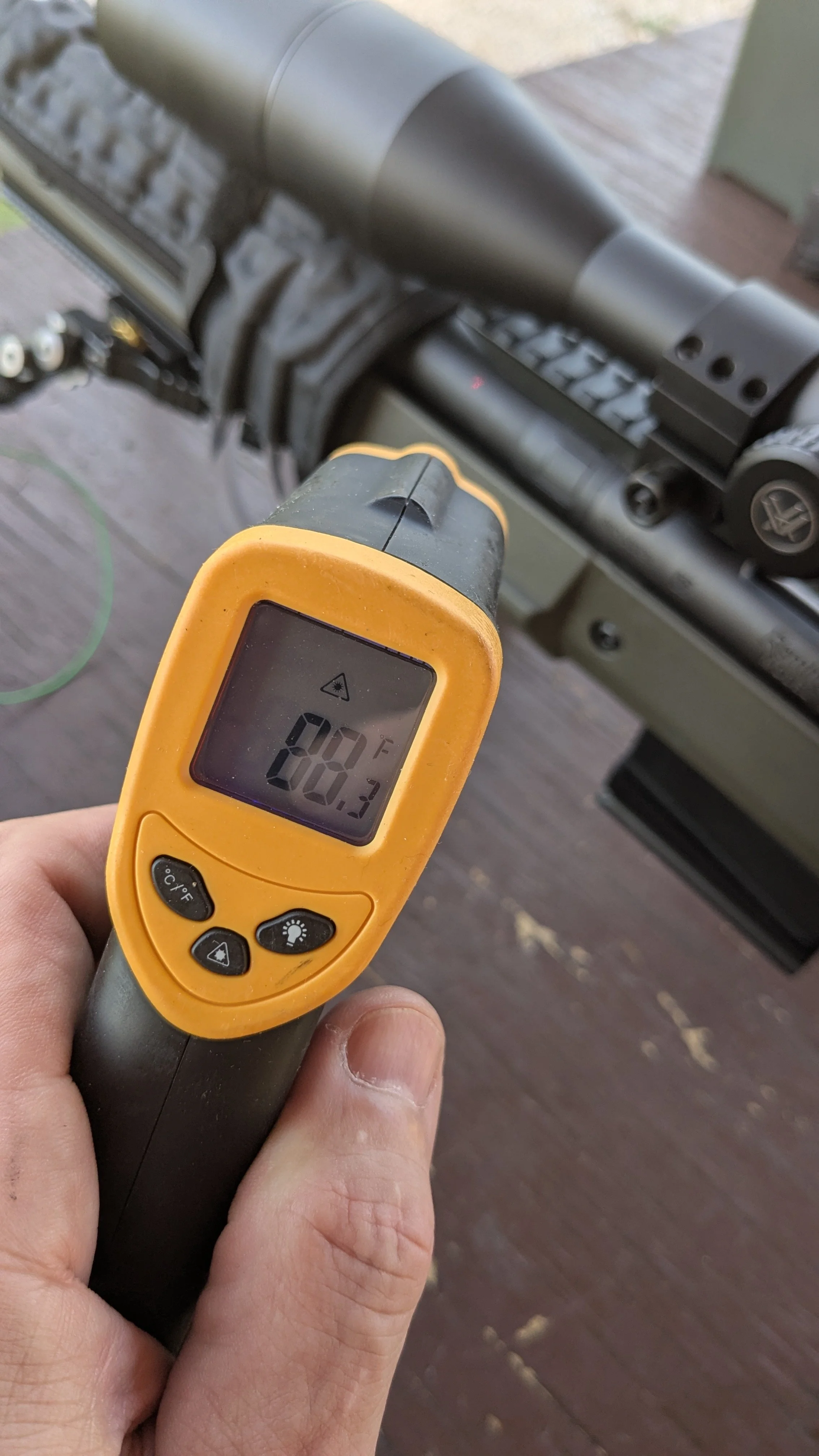
| 7 | 26 | 71.1 | 80.9 | 9.8 | 88.3 |
| End | 30 | not logged | not logged | – | – |
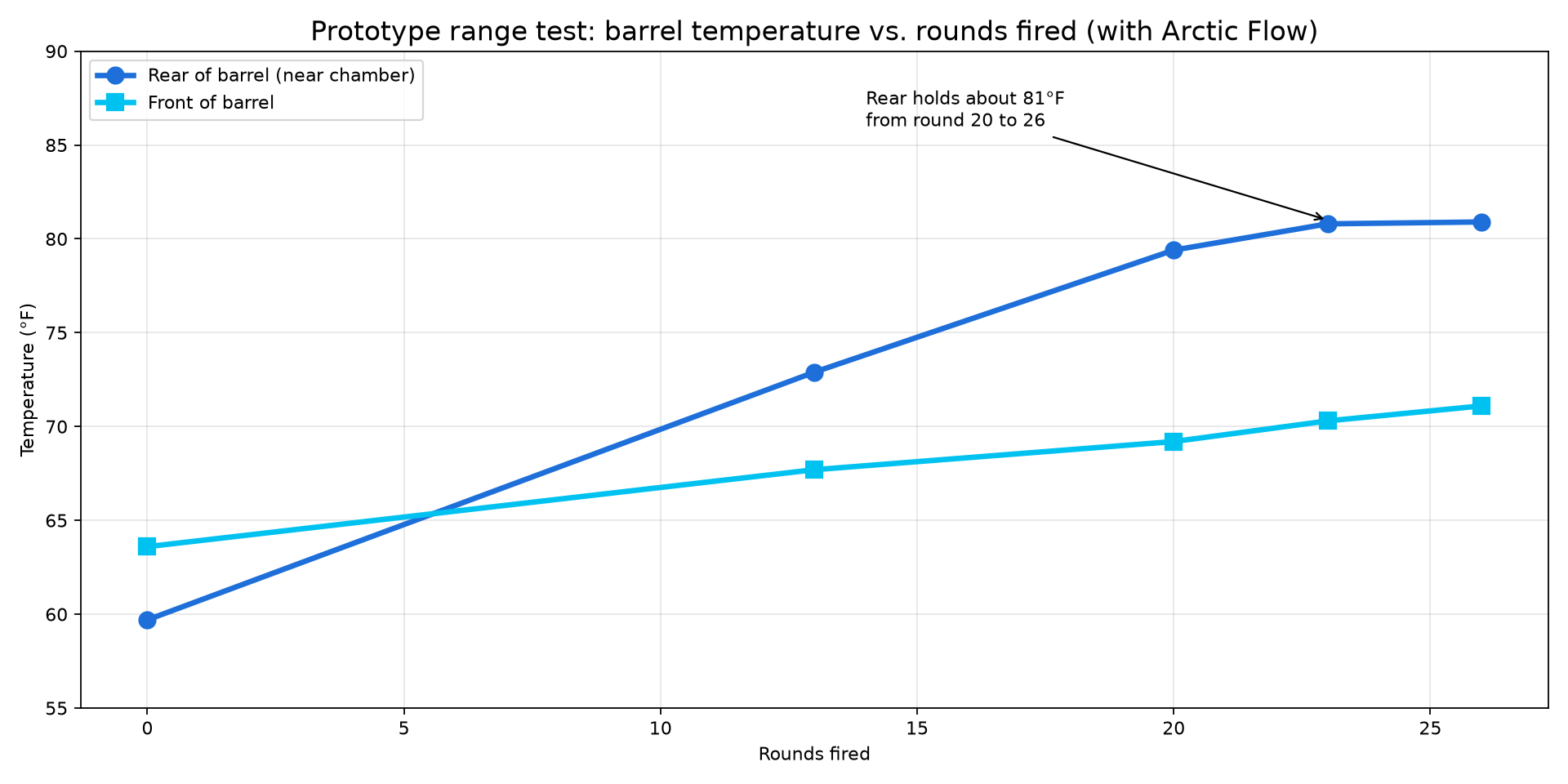
Summary of measured results
- The rear of the barrel, near the chamber, rose about 1°F per shot over the first 13 rounds and about 0.9°F per shot from round 13 to 20, then held at 80.8–81.2°F from round 20 to round 26 while firing continued.
- The front of the barrel rose slowly and steadily, from 63.6°F to 71.1°F over 26 rounds (+7.5°F).
- The rear-to-front difference went from −3.9°F before firing (the rear started colder, consistent with chilled water entering near the chamber) to about +10°F by round 20, then held at 10–11°F.
- The IR gun read 85.1°F and 88.3°F, higher than the thermocouples. These were spot readings aimed near the rear of the barrel and receiver, possibly outside the jacket, and IR readings on shiny metal or fabric are unreliable, so treat them as rough.
9. Thermal model comparison (model, not yet calibrated)
The images in this section are from a computer thermal model, not range measurements. The model has not yet been calibrated against measured data.
Important: the model represents a different barrel and setup from this test. It models a 31 in Savage F/TR-contour barrel in a stock, with a 580 mm mat at the breech, 1 gallon of water at about 45°F plus two ice packs, 75°F air, the 155 gr / 47.0 gr Varget load, and an assumed pace of one shot per minute in still air. The range test used a 26 in full-profile Rem/Age barrel with the mat covering the full barrel, at an unrecorded pace. The model is shown for illustration of how heat moves through a barrel with and without the jacket; it is not a direct prediction of this test.
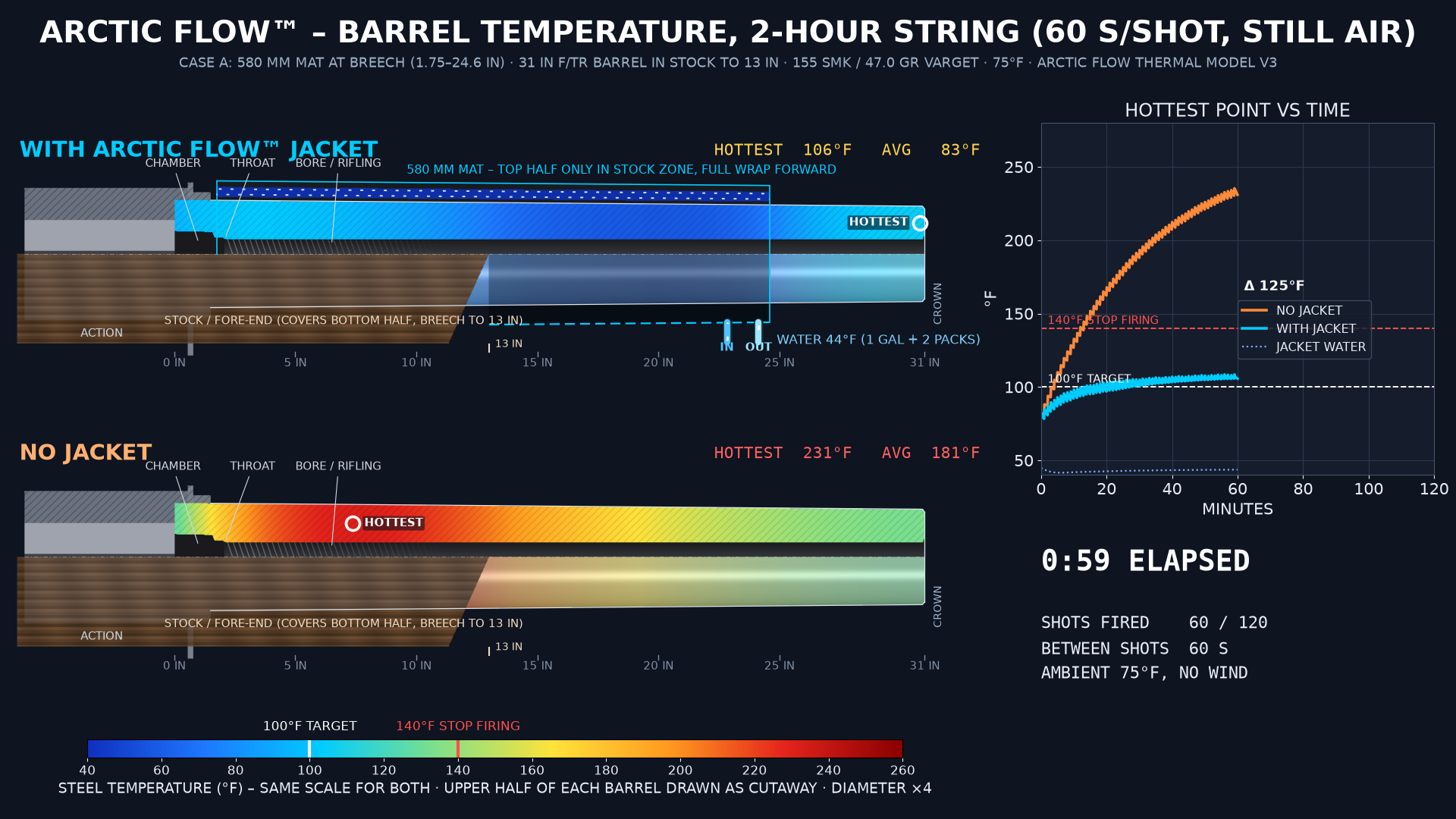
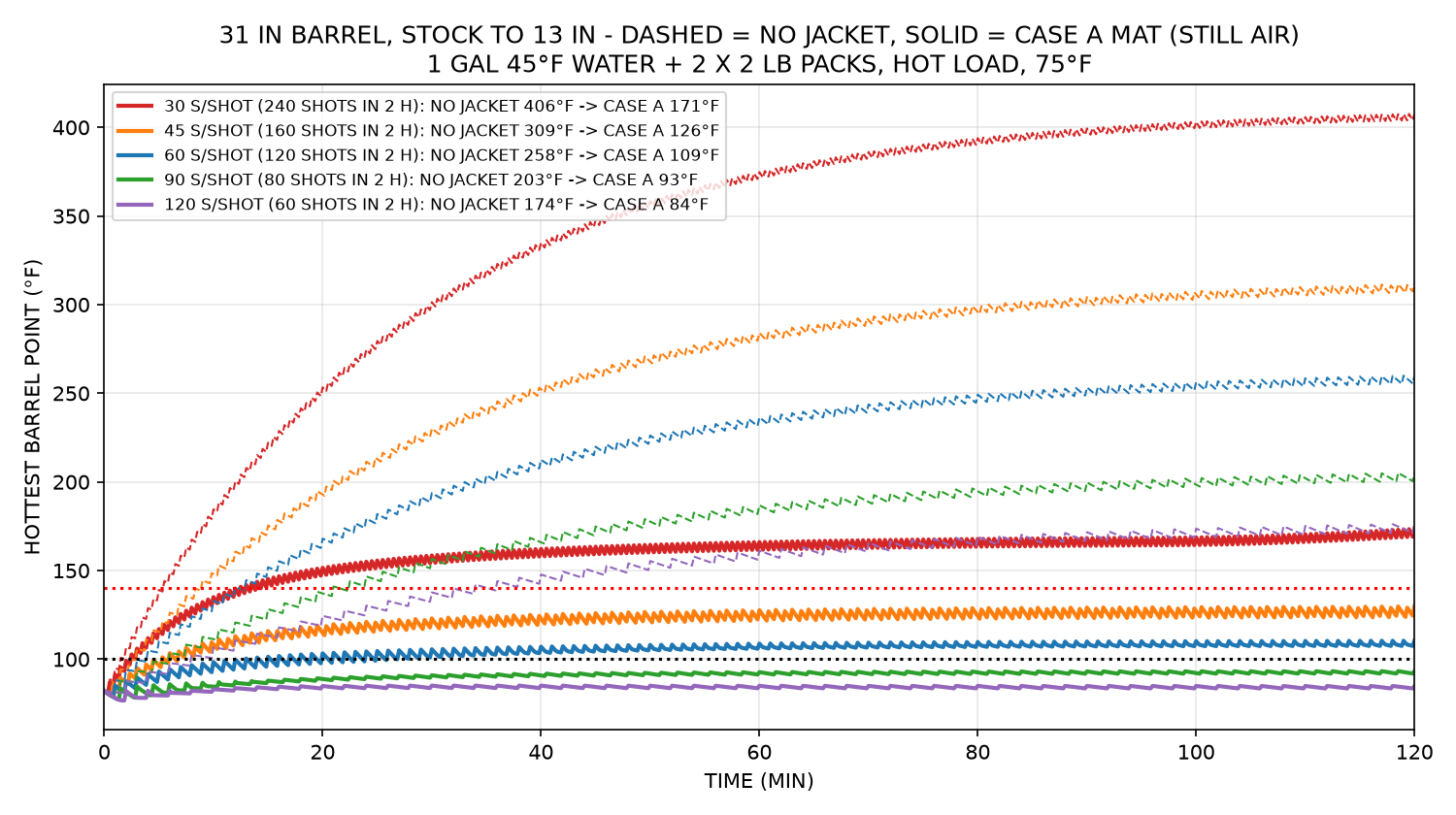
Model estimates of the hottest point on the barrel after a 2-hour string, still air (no jacket → with jacket): 30 s per shot, 406°F → 171°F; 45 s, 309°F → 126°F; 60 s, 258°F → 109°F; 90 s, 203°F → 93°F; 120 s, 174°F → 84°F.
The range test and the model are not directly comparable yet: the range session was a different rifle, about 30 rounds at an unrecorded pace, while the model runs are long strings at fixed paces.
10. Observations and limitations
- Single session, single prototype.
- No control run: there was no uncooled run (no jacket, or jacket on with the pump off) with the same rifle, load, pace and probe locations, so the cooling effect cannot yet be quantified from measured data.
- Shot pace and timestamps were not logged.
- Water temperature at the jacket inlet and outlet, and ice-pack condition, were not logged.
- Pump flow rate and current draw were not measured.
- No reading was taken after the final 4 rounds, and no cool-down curve was recorded.
- The thermal model is uncalibrated.
11. Next tests
- Back-to-back cooled and uncooled runs with the same rifle, load, pace and probe positions.
- Timed shot pace, with a timestamp for every reading.
- On-site ambient temperature, sun or shade, and wind.
- Water temperature at the inlet and outlet, and ice condition over time.
- A documented probe attachment method, and an on-site IR emissivity check.
- A cool-down curve after the last shot, cooled versus uncooled.
- Accuracy and point-of-impact shift per string, with and without cooling.
- Run the thermal model with the 26 in full-profile barrel and use the measured data to calibrate the thermal model.
Measured data come from a single prototype session and are preliminary. Model results are computer estimates and are labeled as such.